

Jul 05, 2023 Allergy Case Study: 63 yr old Male Presenting with Low FEV1/FVC and No Response to Bronchodilator
Patient is a 63-year-old male who presents with daily coughing, wheezing and shortness of breath for the past 3 months. Dyspnea upon exertion has been getting progressively worse during this time. There is no prior history of asthma or allergic rhinitis. Patient has a 45 year-pack history (45 years X 1 pack per day) of cigarette smoking. Patient was hospitalized 2 months ago with Bilateral Pneumonia, confirmed on CXR. Patient also reports COVID five months prior to the office visit, and afterwards developed a lingering cough for about 1 month. The cough is productive. Allergy skin testing to environmental allergens was completely negative. ROS: positive for GERD. No recent changes to environment. Current medication: Trelegy 100 one puff QD and Singulair 10mg QHS. Patient denies any significant improvement with ProAir, but does note mild improvement with Combivent HFA prn.
Past Medical History:
Suspected asthma
s/p COVID
GERD
Current Medications:
Trelegy 100 one puff QD (X1 month)
Singulair 10mg QHS (X 1 month)
Albuterol HFA prn
Combivent HFA prn
Allergies:
Penicillin
Family History:
Positive for atopy.
Environmental Survey:
Positive for 3 dogs. Positive for smokers. Negative for bedroom carpeting.
Smoking History:
45 years pack history (45 years X 1 pack per day)
Diagnostic Tests Performed with the MiniBox+:
Results shown are from the Patient Report
(click for larger view)


Spirometry – severe obstructive defect with FEV1 = 25% of predicted at baseline, FEF 25-75 = 15% of predicted at baseline. FEV1% = 52% of predicted.
There was no significant bronchodilator response upon receiving two puffs of albuterol.
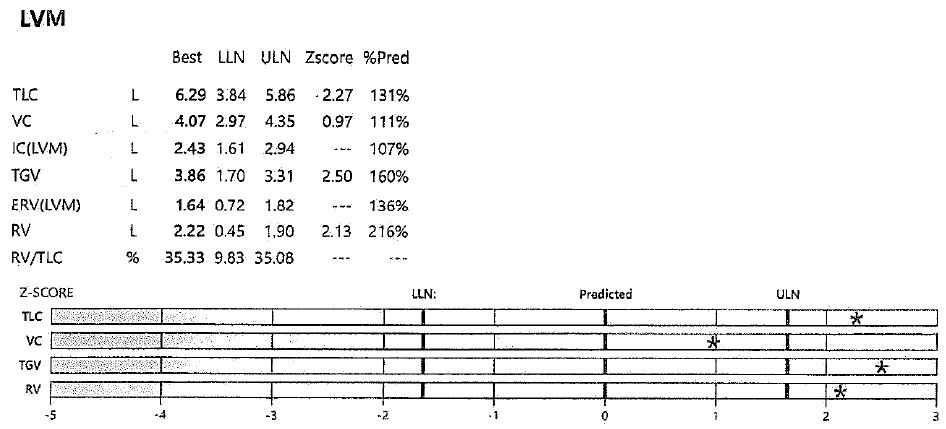
Lung Volumes – Normal TLC. Elevated RV and RV/TLC ratio.
DLCO – 36% of predicted
Assessment & Plan:
This 63 year-old male presents with progressive dyspnea for the past 3 months. History is significant for extensive cigarette smoking and COVID. There is a history of GERD. The clinical presentation in conjunction with a combined obstructive and restrictive ventilatory defect on spirometry, elevated RV/TLC, and low DLCO is suggestive for the diagnosis of Emphysema.
The following recommendations were made to the patient:
- Emphysema
- Pulmonary Function Testing demonstrates a combined Obstructive and Restrictive Ventilatory Defect. FEV1/FVC = 51% of predicted, which could be predictive of asthma. However, there are no signs of reversibility with a bronchodilator.
- There are signs of an intrapulmonary restrictive ventilatory defect given the elevated RV/TLC and decrease in DLCO. These pulmonary function test findings are consistent with Emphysema.
- Pulmonary consult for further evaluation and treatment.
- Unlikely Asthma – reasons stated above.
- GERD
- GI consult
Conclusion:
The performance of lung volumes and DLCO measurements in the office provided additional information that enabled a diagnosis of emphysema.
Submitted by Jeffrey Weiss, MD, Weiss Medical – Allergy, Asthma & Immunology, www.weissmedical.